
1.2714+A Steel | 1.2714+QT Steel
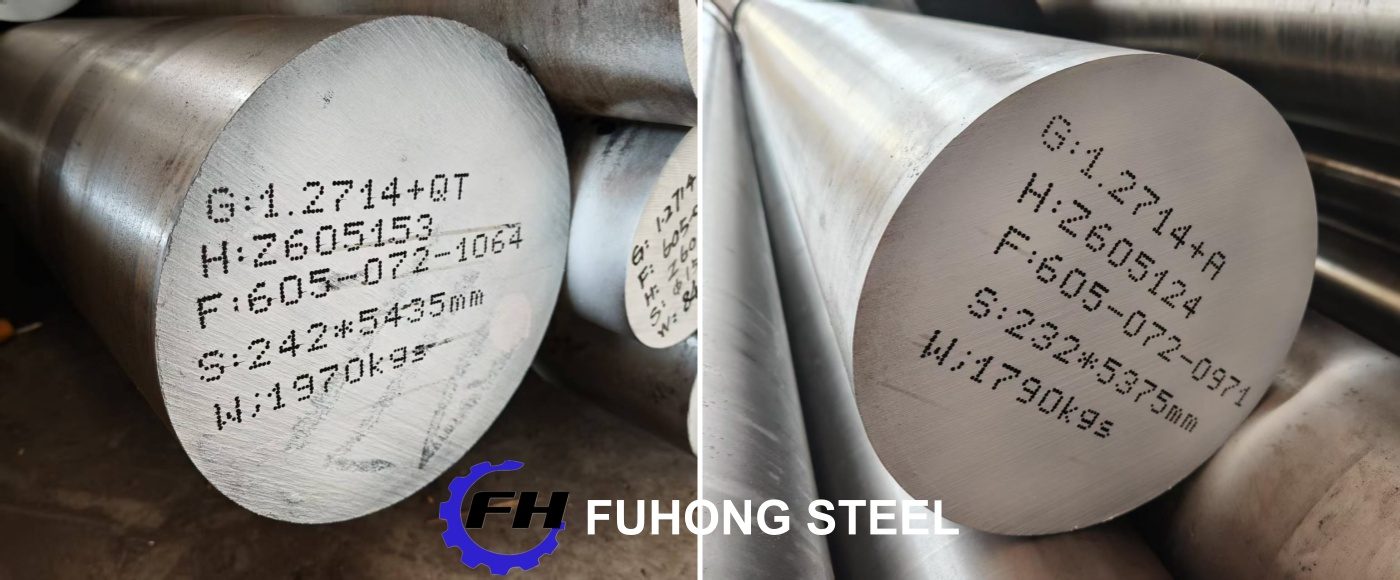
1.2714 steel, also known as 55NiCrMoV7, plays a crucial role in hot forging processes. Most suppliers offer two delivery conditions: +A (soft annealed) and +QT (quenched and tempered). Although the steel composition and chemical composition are the same, these two conditions perform very differently in actual workshop applications.
What is 1.2714 Steel?
1.2714 is a nickel-chromium-molybdenum-vanadium hot-work tool steel conforming to DIN EN ISO 4957 standards. Its European designation is 55NiCrMoV7. You may also meet its equivalent names: AISI L6, Italian DB6, Japanese SKT4, or French AFNOR 55NCDVV7.
| Grade | C | Si | Mn | P | S | Cr | Ni | Mo | V |
| 1.2714 | 0.5-0.6 | 0.1-0.4 | 0.6-0.9 | ≤0.03 | ≤0.03 | 0.8-1.2 | 1.5-1.8 | 0.35-0.55 | 0.05-0.15 |
The nickel content is what makes 1.2714 steel interesting. Nickel gives the steel toughness, so dies made from 1.2714 take impact and repeated thermal cycling without chipping.Furthermore, this steel exhibits deep hardening properties, which are crucial for large dies.
What do the Suffixes “+A” and “+QT” Mean?
The suffix indicates the delivery condition, the state of the 1.2714 steel when it leaves the mill. It doesn’t indicate a different steel grade, but rather a change in its heat treatment method, not the material itself.
“+A” means soft annealed.The highest delivery hardness is approximately 240–248 HB (about 23 HRC), making the billet easy to machine. You can cut it to the desired shape yourself and then quench and temper it.
“+QT” means quenched and tempered.The steel delivered by the mill is pre-hardened, typically with a hardness of 360–410 HB (37–44 HRC), with a common upper limit of about 420 HB. You finish-machine it and put it straight into service.
Comparison: 1.2714+A vs 1.2714+QT
| 1.2714+A (annealed) | 1.2714+QT (quenched & tempered) | |
| Delivery hardness | ≤ 240–248 HB (≈ 23 HRC) | 360–410 HB (37–44 HRC; typical cap 400 HB) |
| Microstructure | Soft annealed, machinable | Hardened and tempered |
| Machinability | Excellent; fast cutting, clean finish | Workable, but slower with more tool wear |
| Processing route | Machine → harden → temper → finish | Machine → finish; ready to use |
| Distortion risk | Hardening step can distort | Low; dimensions stable |
| Hardness flexibility | Full control via tempering | Fixed delivery range |
Heat treatment:From 1.2714+A to 1.2714+QT
If you have chosen 1.2714+A steel and wish to further obtain 1.2714+QT, the recommended process is as follows:
1. Preheat in two steps: first, raise the temperature to 350–450 °C, then to 650–750 °C.
2. Perform austenitization at 850–870 °C, followed by oil quenching.
3. The hardness after quenching is approximately 56–58 HRC.
4. Temper immediately after quenching to prevent cracking.
Typical hardness after tempering
| Tempering Temperature | 400-480℃ | 500-550℃ | 570-650℃ |
| Hardness | 42-46HRC | 38-41HRC | 32-36HRC |
For 1.2714+A steel machined in soft condition, a stress-relief anneal at 600–650 °C after rough machining lowers the distortion risk before final hardening.
Where is 1.2714 Steel Used?
- Hammer and press forging dies
- Die holders, die blocks and bolster plates
- Hot shear blades and hot punches
- Extrusion dies, punches and containers
- Hot stamping and bending tools
- Large plastic moulds and compression moulds
- Tool holders, pressure plates, slides and spindles
Compared to grades like H13, 1.2714 steel sacrifices some high-temperature hardness in exchange for significantly higher toughness. If the mold needs to withstand impact and thermal shock, rather than being exposed to extreme surface temperatures for extended periods, then 1.2714 steel is generally a safer choice.


