
1.2312+QT Tool Steel
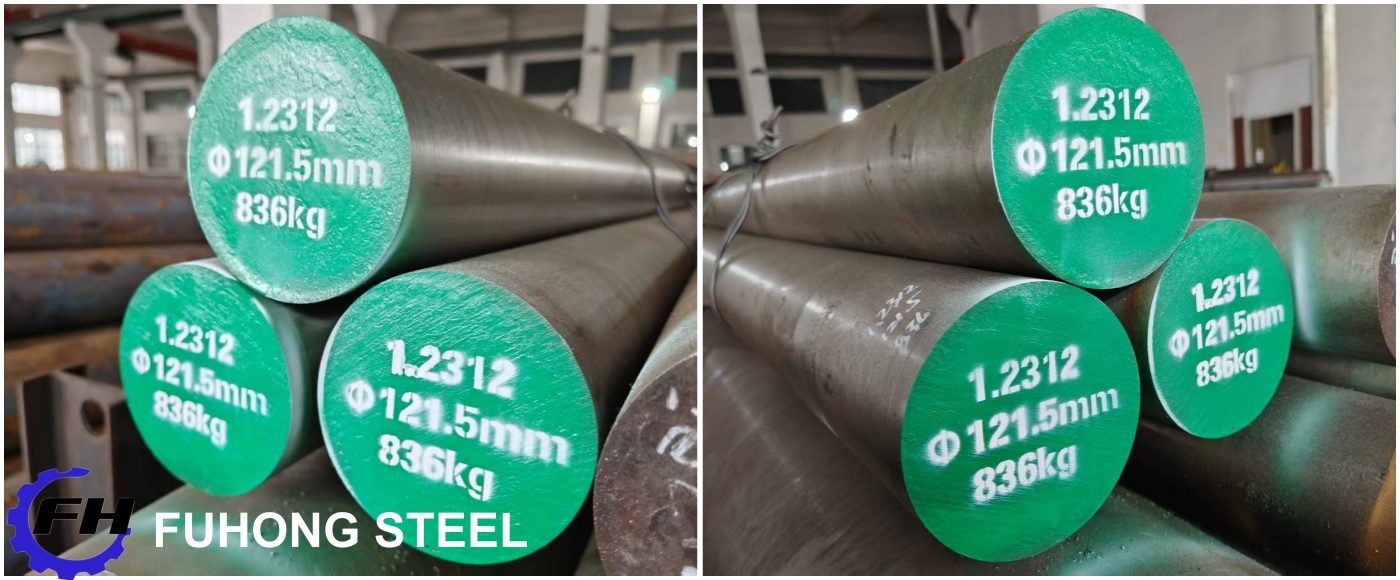
For plastic mold steel, P20 is a safe choice, while 718H is suitable for large molds. What about 1.2312 steel?
What Exactly is 1.2312 Steel?
1.2312 is the Werkstoff designation for DIN/EN 40CrMnMoS8-6, a chromium-manganese-molybdenum cold work tool steel primarily used for plastic molds. You can think of it as a P20 type steel, but with a deliberate alteration: approximately 0.05%–0.10% sulfur is added during the smelting process.
| C | Si | Mn | P | S | Cr | Mo | |
| 1.2312 | 0.35–0.45 | 0.30–0.50 | 1.40–1.60 | ≤ 0.03 | 0.05–0.10 | 1.80–2.00 | 0.15–0.25 |
That single element changes the character of the material. Sulfur forms manganese sulfide inclusions that act as chip breakers during machining. The practical result: the steel cuts faster, drills cleaner, and treats your tooling better than the sulfur-free 1.2311.However, these inclusions also make mirror polishing more difficult.
1.2312 Steel: What does Pre-hardened Condition Mean?
Pre-hardening represents quenching and tempering. At the factory, 1.2312 steel has already undergone quenching and tempering, resulting in a uniform hardness range, typically 280–325 HB (approximately 29–33 HRC). The specific hardness depends on the mill and section size.
For the mold maker this removes a whole process step: no pre-hardening before machining, no risk of distortion from a later heat treatment, and uniform hardness across large cross sections. Additionally, 1.2312 steel stays dimensionally stable while you cut it.
1.2312 vs 1.2311
| Property | 1.2312 (40CrMnMoS8-6) | 1.2311 / P20 |
| Sulfur | 0.05–0.10% | 0.030% max |
| Machinability | Noticeably better: chip breaking, cleaner drilling | Good, but slower on large stock removal |
| Polishability | Limited, technical polish only | Better, higher finish possible |
| Delivery hardness (QT) | ~280–325 HB | ~280–310 HB |
| Typical use | Frames, base plates, support parts | Frames plus cavity inserts where finish matters |
Where is 1.2312 Steel Used?
1.2312 is a frame and structural grade first. Application lists : high-strength mold frames, base plates, medium to large plastic injection molds, tools for thermosets and thermoplastics, and structural parts in mechanical engineering.
Real examples include molds for seating furniture, bottle crates, buckets and tubs, big-box parts where the frame does a lot of work and the cavity never needs an optical finish.
To keep this honest,1.2312 steel also has some limitations:
- Polishability: technical polishing only. The sulfur inclusions stop it from reaching a high-gloss finish.
- Hardness ceiling in QT delivery: about 34HRC. If the application needs higher hardness as-delivered, this is the wrong grade.
- Not a hot-work or high-wear steel: for aluminum die-casting cavities or high-wear inserts, look at H13 / 1.2344, or add nitriding on top of this material.
Buying mold steel is mostly about matching the grade to the job, not chasing the “best” steel. 1.2312 QT is the right answer when you have a big frame, a lot of machining, and no mirror finish in the spec.


